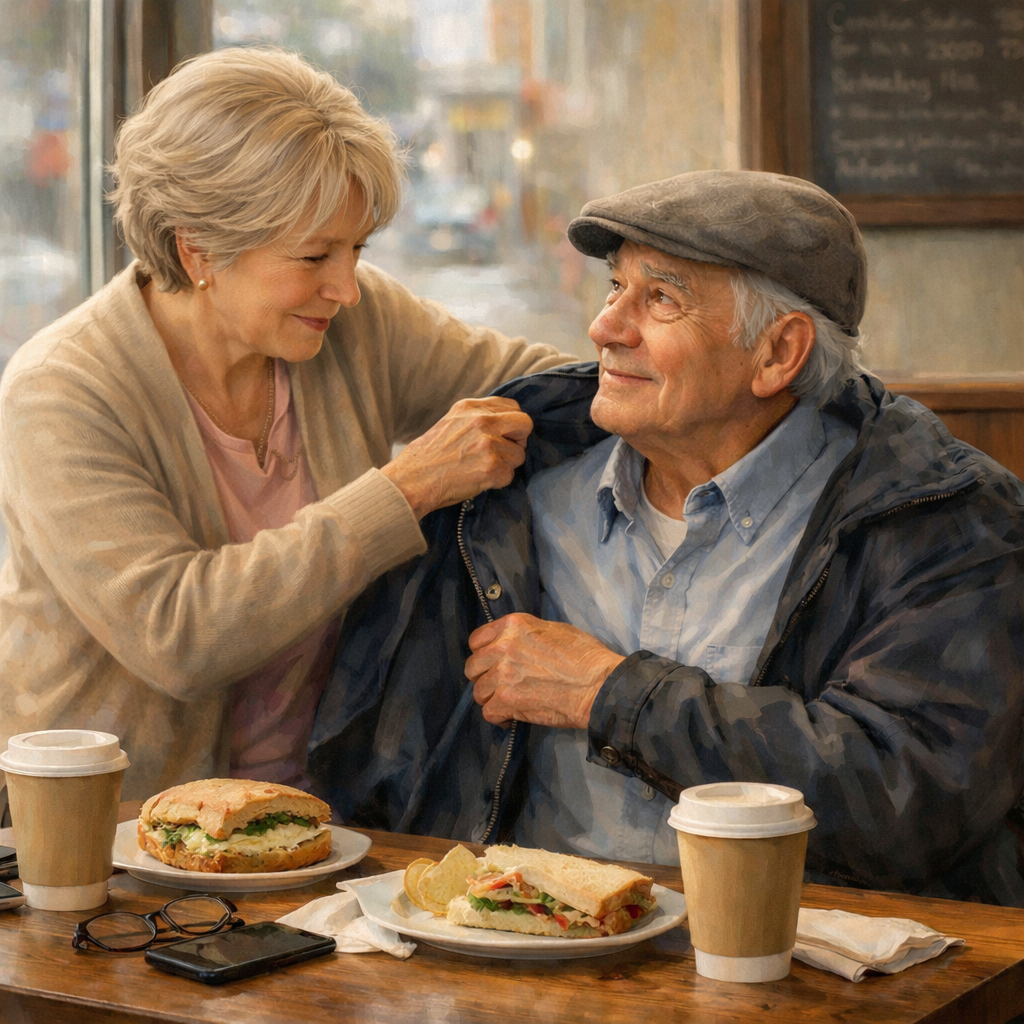
They sat by the window. Two paper cups steaming like little chimneys. His sandwich was chicken salad, no lettuce. Hers was tuna, cut diagonal. They had settled into the corner booth like regulars, though I’d never seen them before. Maybe they came on Wednesdays. Maybe I’d just missed them every time.
He was still working on his jacket. That was the first thing I noticed. It was halfway off, tangled at the elbow. One arm out. One stuck. The kind of thing that used to take a second, and now takes a minute. Or longer. His mouth was tight, not annoyed, just concentrating. The way you do when you’re trying not to drop anything or swear in public.
She watched him. Not with worry. Not with pity. Just eyes, plain and waiting.
Then she moved. Quietly. Like it wasn’t the first time. Like it wasn’t the hundredth. Just reached across the table and tugged the cuff loose. Folded the sleeve down. Her hands small and sure. Not quick. Just… precise.
She didn’t say a word.
And neither did he.
But he looked at her.
Not the kind of look you give a stranger who holds the door. Not the polite nod kind of gratitude. This was older. Something worn into the face, like grooves in a cutting board. The thank you lived in his eyes. Heavy and quiet. A thank you that had been said so many times, it no longer needed saying.
She looked away after that. Not shy, just done. She opened her sandwich. Brushed a crumb off the wax paper. He leaned back. Loosened his collar. Wiggled his fingers like they were thawing.
The table between them didn’t hold hands. Didn’t trade smiles. Just two cups. A napkin. A soft silence that didn’t ask to be filled.
And I thought—this is it.
Not romance. Not the sort that gets songs or ruins sleep. This was something else. A kind of loyalty so unadorned it almost looked like habit. A version of love that had long since stopped needing to be noticed.
I’ve heard people say you grow together or grow apart. But I think you wear each other in. Like boots. Like stairs. You start out stiff. Beautiful maybe, or loud, or clever. But uncomfortable. Then over time, you scuff and warp and lose all the shape you once had, and that’s when it starts to fit right. That’s when the creaks stop sounding like weakness.
That’s what it felt like, watching them.
There’s a certain kind of dignity in growing older in front of someone. The kind of person who’s seen you grumble at shoelaces or curse at the remote or lose the thread of a story halfway through. Someone who knew the color of your hair before it gave up. Who remembers when you had a waist. When you had all your teeth.
But more than that. Someone who doesn’t flinch when your body betrays you.
Because it will. Every body does. Knees go weird. Backs seize up. Fingers get clumsy. Things that used to be automatic—like jackets—turn into projects. And that’s when you need someone who won’t treat you like broken glass.
She didn’t fuss over him. Didn’t coo or cluck. Didn’t say “here, let me.” She just saw the thing needed doing. And did it. Like checking the oven. Like pulling a weed.
That kind of help—quiet help—is its own language.
It’s not flashy. It’s not the stuff of movies. But it’s a promise kept in motion. A vow that doesn’t need a witness. And it doesn’t announce itself. That’s the whole point. Love, at a certain age, stops needing permission to exist.
I don’t know their names. I don’t know if they argue. I don’t know what kind of parents they were or what job he retired from or if she still bakes on Sundays. But I know what I saw.
I saw a man too proud to ask for help, and a woman who knew better.
I saw a jacket halfway off, and a hand that knew how to finish the job.
And I saw a look.
Not a flashy look. Not hearts-in-the-eyes. Just one of those weary, grateful glances that says everything without turning it into a scene.
That’s the thing about loyalty. It doesn’t wave a flag. It just shows up. Day after day. It’s not the big moments that prove it. It’s the ones nobody else notices. The stupid little things that feel too small to write down.
Like helping with a sleeve.
Or not saying thank you out loud.
Or ordering the sandwich without lettuce because he always forgets to ask.
People get distracted by the loud parts of love. The declarations. The disasters. The chase, the breakup, the getting back together. But I think the real stuff is here. In the mundane. In the slow dance of ordinary days.
Two people. A window seat. A lukewarm lunch. The warmth of old routines.
I stayed longer than I meant to. Pretending to sip. Letting my drink cool into the shape of the air. I watched them finish their meal, quietly. He folded the wrappers. She wiped the table with the edge of a napkin.
When they left, he didn’t push his chair in. She did. He held the door. She touched his arm on the way through.
No fanfare.
Just an old rhythm. Practiced and precise.
And I sat there thinking how loud the world is now. How obsessed we are with being seen, with being heard, with being big. But the best parts of being human might be the invisible ones.
The sleeve. The glance. The crumb.
The chair tucked in behind someone who didn’t remember to do it. Or couldn’t.
Maybe that’s love. Not a feeling. Not a lightning bolt. Just the quiet work of helping each other stay human. Every single day. Even when the jackets get complicated.
Especially then.