“Eyes down,” he said. “Everybody’s good. Stay good.”
Nobody believed him, but they stayed down anyway. Faces in carpet. Hands over heads. A stroller parked crooked like somebody left it in a hurry. The security guard sat against the wall with his wrists zip-tied and his mouth open, breathing like he had a cold.
The fluorescent lights didn’t flicker. They just murmured, steady, like this was a normal Tuesday and not a room full of people waiting for something bad to happen.
Behind the glass of the manager’s office, a printer kept chattering in short bursts. It sounded like a robotic bug dying.
Milo had one earbud in. The kind you could hide if you turned your head the right way. It clicked once, a soft burst of static.
“Nia,” he said, barely moving his lips.
“I’m here,” she said. Calm. Like she was sitting at a stoplight with a coffee. “Car’s warm. I got eyes on the lot and the doors. No uniforms yet.”
“Keep it that way,” Milo said.
“I’ll try,” she said. “We got a guy across the street in a gray Civic. Phone up. He’s pretending he’s not pretending.”
Milo looked straight ahead. He didn’t glance at the windows. He didn’t give the lobby any new motion to track.
“Could be nothing,” he said.
“Could be,” Nia said. “But it’s early for nothing.”
Milo let that sit. The kind of early you felt in your gut.
In the lobby, Chet paced with the gun like it was a prop he kept forgetting how to hold. Up. Down. Up again. He kept sweeping it over faces on the floor, not aiming, not not aiming. Every pass made people tighten like they were trying to shrink into the carpet.
Chet liked being watched. He liked it too much.
Darlene Sato sat at her desk inside the glass office. Mid-forties. Hair pinned tight. Blazer. Bank badge clipped like a little shield. Her hands were steady on the keyboard, which didn’t match the room. People in a bank robbery didn’t type steady unless they’d been in worse rooms than this.
Milo stood in the office doorway, shoulder on the jamb, blocking without making it obvious he was blocking. He kept his pistol low. More a reminder than a threat.
He watched Darlene’s screen and tried to keep his voice bored.
“Just do the transfer,” he said. “You do it, you go home.”
Darlene didn’t look at him. She looked at the screen like it was a prayer she didn’t believe in.
“It won’t go,” she said.
Milo leaned in a fraction. “Why.”
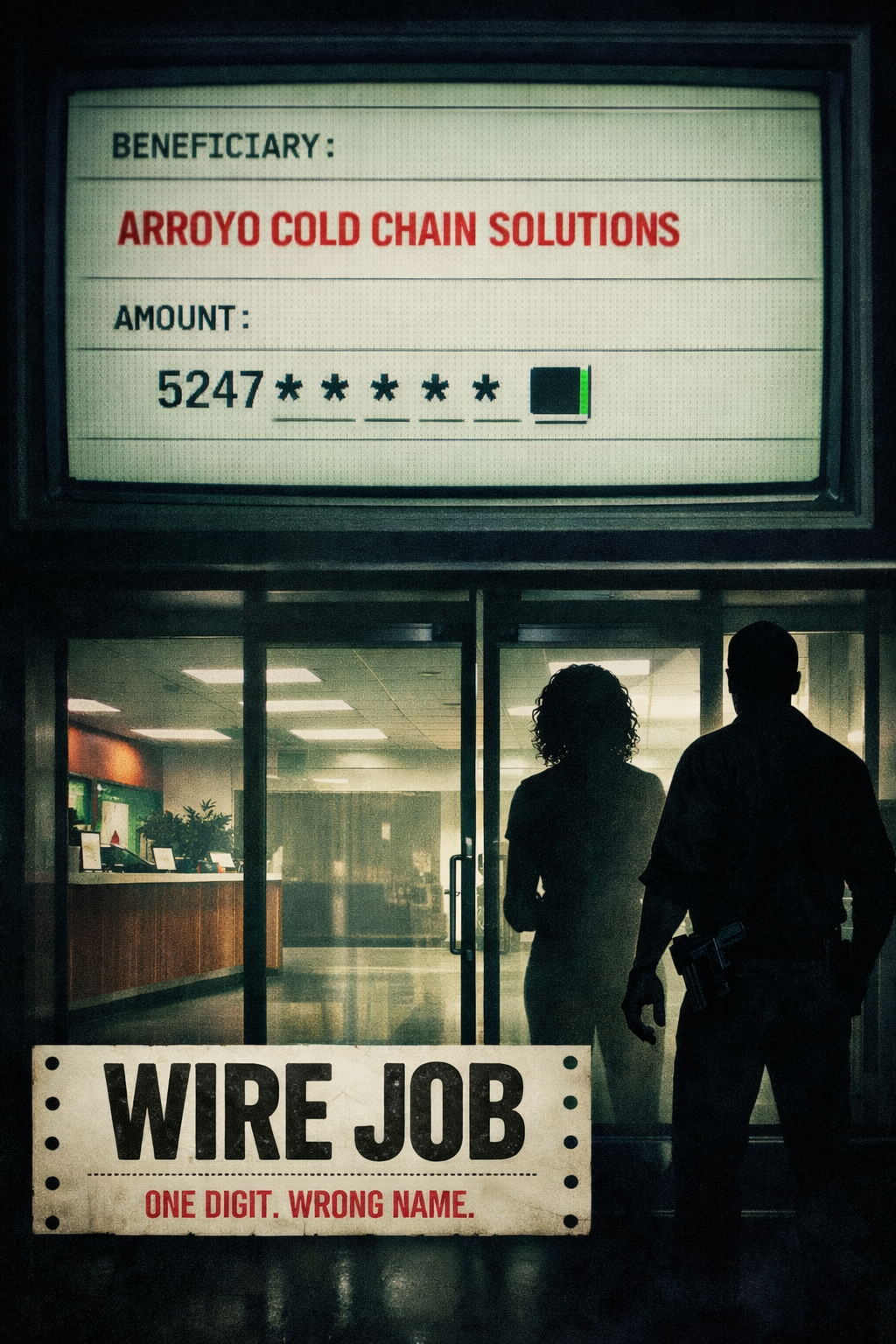
Her cursor blinked in a little empty box on the wire form. Everything else was filled in. Amount. Routing. Names that didn’t mean anything to Milo. Then one blank square at the end like a missing tooth.
“It’s incomplete,” Darlene said.
Chet stopped pacing. He stepped closer, drawn by the word like it was food.
“Don’t do that,” Chet said.
Darlene’s eyes stayed on the screen. Milo’s eyes stayed on her hands.
“What’s incomplete,” Milo asked.
Darlene lifted her pen and tapped the monitor. The last box.
“One digit,” she said. “The account number is short.”
Milo felt the plan tear in his hands, even though he wasn’t holding paper. One digit wasn’t a big mistake. One digit was the whole thing. One digit meant you couldn’t talk your way through the door.
Chet pushed into the doorway, shoulder past Milo, close enough Milo caught the sharp smell of mint gum.
“You telling me we came in here for nothing?” Chet asked.
Milo didn’t look at him. He kept his eyes on the screen. “Back up.”
Chet laughed once. A hard, quick sound. “Back up. Listen to him.”
In the lobby, someone made a small noise—could’ve been a cough, could’ve been a sob. Milo didn’t turn. Turning was a gift to panic.
He said to Darlene, “There’s no override.”
Darlene hesitated. Just a blink too long.
“The system won’t accept an incomplete account,” she said. “It rejects it.”
Chet leaned in, teeth showing. “Then make it complete.”
Darlene’s gaze flicked—fast—to a sleek black phone on the right side of her desk. Not the old gray one with the scuffed buttons. The new one that looked like it belonged in a law office.
Milo saw it. Filed it away.
“What’s that line,” he asked.
Darlene’s jaw tightened. “Private.”
“Private,” Chet repeated, pleased. “That sounds like a shortcut.”
Milo kept his tone flat. “There are no shortcuts.”
Chet’s eyes went past Milo to the people on the floor, like he wanted them to hear him win. “Sure there are. Everybody’s got shortcuts.”
Milo didn’t argue with Chet when Chet had an audience. You didn’t hand him a stage. You took it away.
He said, “Darlene. One digit. That’s it.”
Darlene nodded once, small.
Chet lifted the gun slightly, not quite pointing at her, but the room felt it anyway. “So put a digit in.”
Milo heard Nia again, faint in his ear, like she was careful not to step on something sharp.
“Two cars just turned the corner,” she said. “Could be commuters, could be not.”
Milo said softly, “Keep watching.”
Chet’s voice rose. “You hear me? Put a digit in.”
The robbery had started as a plan. Now it was about Chet not feeling stupid. That was worse.
Milo looked at the empty box on the screen. He pictured the Professor’s torn card. The ink smear where the last number should’ve been. The Professor’s clean hands passing it over like it was nothing.
One digit.
He asked Darlene, “What happens if we guess wrong.”
Darlene didn’t answer right away.
Chet answered for her. “We don’t guess wrong.”
Milo turned his eyes to Darlene. “Answer.”
Her mouth opened, closed. Her calm didn’t crack. That was the part that kept bothering Milo.
“The money goes somewhere else,” she said.
Chet made a noise like a laugh and a cough at the same time. “Somewhere else. Like we can’t go get it.”
Milo thought about wires like doors you couldn’t kick. Money turning into numbers. Numbers becoming gone.
He also thought about Chet’s finger and how little pressure it took. About the way the lobby was full of soft targets and hard consequences.
Milo said, “We don’t have time to fight about it.”
Darlene’s eyes met his. For the first time, her calm shifted into something like warning.
“You don’t want to do this,” she said.
“Why,” Milo asked.
She shook her head, small again. “Because—”
Chet slapped his palm on the desk, hard enough to rattle the pen cup. The printer in the corner answered with a burst of chatter like it was laughing too.
“Because nothing,” Chet said. “Because you’re stalling. Put a number in.”
The woman by the stroller made a thin sound, like she tried to breathe and didn’t get enough. Milo wanted to tell her it was fine. He didn’t. Fine was a lie you said to make yourself feel better.
He leaned closer to the screen. The cursor blinked in the empty box like it had all day.
Pick a digit.
Milo’s mind grabbed the first solid thing it could. His old union local number. The patch on his jacket from when he still had a jacket with a name stitched on it and a job with a start time. The last digit on the local.
Four.
Not luck. Not faith. A railing.
Milo said, “Put four.”
Darlene stared at him like he’d asked her to jump.
“Four,” Milo repeated. “Now.”
Her fingers hovered over the keys. For the first time, a tremor hit her hand. Once. Then she typed.
The box filled. The little red warning mark disappeared. The screen paused like it was thinking about punishing them.
Milo held his breath without meaning to.
Then the form refreshed.
A beneficiary name populated in a line Milo hadn’t noticed before, and it hit the room like a smell.
ARROYO COLD CHAIN SOLUTIONS, LLC.
Darlene went still. Not frozen like she’d been caught. Still like she’d heard a familiar voice in the dark.
Milo felt the shift before he understood it. The air got heavier.
Chet leaned over Milo’s shoulder and read it. Milo watched his face.
Chet’s grin drained away. His eyes widened a fraction. Then he shut them down hard, like he’d been trained not to show fear.
He whispered, “No.”
Milo turned his head just enough. “You know it.”
Chet swallowed. His jaw worked like he was chewing something tough.
“Yeah,” Chet said. His voice came out smaller than Milo expected. “I know it.”
Milo kept his voice level. “Tell me.”
Chet looked out at the lobby like he needed to make sure the gun still mattered.
“That’s trucks,” he said. “Cold chain. Warehouses. Docks.”
“That’s a company,” Milo said.
Chet made that half-laugh again, bitter. “Sure. Like a church is just a building.”
Darlene’s eyes stayed on the name. She didn’t blink.
Milo said to her, “What is it?”
Darlene’s throat moved. She glanced at the sleek phone again, like it was a loaded gun.
“You need to leave,” she said.
Chet snapped, “We leave when we’re done.”
Darlene shook her head. “Not because of police.”
Milo felt the shape of something sliding into place, like a lock catching.
He said, “Who.”
Darlene opened her mouth…
The sleek black phone chimed.
It didn’t ring like a normal desk phone. It was a tight, polite tone, no urgency. Friendly.
Darlene’s hand moved to it before she could stop herself.
Milo caught her wrist.
“Don’t,” he said.
Darlene looked at him. For the first time, her calm broke into pleading.
“If I don’t answer,” she said, “they’ll come anyway.”
Chet leaned in, hungry again. “Who’s they.”
Milo didn’t like the word come. He didn’t like anyway.
The phone chimed again.
Outside, far off, a siren wailed and then dipped as it moved, that doppler sound turning the air into a countdown. Milo didn’t feel relief. Cops had procedure. Cops wrote reports. Cops could be slowed down by rules.
The sleek phone didn’t sound like rules.
Milo said, “Answer. Speaker.”
Darlene’s fingers shook as she pressed a button.
A man’s voice filled the office, smooth and close to bored.
“Darlene,” the voice said. “Say yes if you can hear me.”
Darlene closed her eyes for half a second, like the name hurt.
“Yes,” she said.
Chet leaned closer to the phone. Milo didn’t. Milo watched Darlene’s face and listened for what she wasn’t saying.
The voice said, “You have a situation.”
Darlene didn’t answer.
The voice said, “I need you to look at the beneficiary line on the pending transfer. Confirm the name.”
Milo said, “Don’t.”
Chet whispered, “Do it.”
Darlene’s eyes went to the screen. She didn’t want to read it aloud. Like speaking it made it real.
“Arroyo Cold Chain Solutions,” she said.
A pause. Not surprise. Math.
“Thank you,” the voice said. “Now I’m going to ask you a question. Yes or no. Are there weapons displayed.”
Darlene’s eyes flicked to Milo’s hands. Milo kept his pistol low, out of the lobby’s view, but it was still there. The lie would be thin.
Milo said, quiet, “No.”
Darlene swallowed and echoed him. “No.”
Chet hissed, “What the hell—”
The voice didn’t acknowledge him. “Understood,” it said, calm as a banker.
Milo said, “Who are you.”
Another beat, and Milo heard a smile without warmth.
“You don’t need my name,” the voice said. “You need to leave the building.”
Chet barked a laugh. “Or what.”
“Or you’ll still be in there when my people arrive,” the voice said. “And then the police won’t be your biggest concern.”
Darlene flinched like the voice had slapped her.
Milo felt cold spread under his ribs from the certainty in the answer.
The printer chattered again. A sheet of paper fed out, warm, black ink. Routine. Proof. The bank documenting its own trouble.
Milo’s earbud clicked.
“Nia,” he murmured.
Her voice came back, tighter. “Milo. Gray Civic just left. Like he got what he wanted.”
“What else,” Milo asked.
“Nothing with lights,” Nia said. “But, hold up.”
Milo watched Darlene. Darlene watched the phone like it could bite her.
Chet’s gun lifted.
“Tell him to go to hell,” Chet said.
Milo said, “Chet, shut up.”
Chet’s eyes snapped to Milo. “Make me.”
Milo stared back. He didn’t blink. He kept his voice down. “You want to go home, you listen.”
Chet’s jaw clenched. Pride fighting fear. Milo could see fear winning, and that made Chet unpredictable.
On the speaker, the voice said, “Darlene. Walk away from the desk.”
Darlene didn’t move.
Milo looked through the glass toward the front doors. He kept his head still, just shifted his eyes.
A black SUV rolled into the lot slow and clean, no lights, no rush. It slid into a space close to the entrance like it had an assigned spot.
Two people got out.
One wore a nice coat and carried a folder like he was headed to a meeting.
The other carried nothing. Hands loose. Shoulders relaxed. He looked at the bank doors like he was looking at a refrigerator he planned to open.
Milo’s earbud crackled.
“Nia,” he said.
“Company just rolled in,” she said. “Black SUV. Two out. They’re walking in.”
“Cops?” Milo asked, though he already knew.
“Not cops,” Nia said.
Milo felt the whole job tilt on its axis. Cops were a storm you could see coming. This was something that walked in the sun and didn’t care who saw.
He leaned in and ripped the fresh wire printout from the printer tray. He didn’t read it. He folded it once and stuffed it into his jacket pocket on instinct, like a man grabbing a receipt because he might need to prove something later.
Darlene’s eyes widened at the paper in his hand like he’d just picked up a live snake.
Milo said, “How far behind are they.”
Darlene whispered, “They’re not behind.”
The voice on the speaker said, “Darlene, listen carefully. If there are civilians in the lobby—”
Chet cut in, loud, “Hey! You talking about us like we ain’t here.”
The voice ignored him again, which made Milo’s skin crawl more than any threat.
Milo turned to Chet. “We’re leaving.”
Chet’s eyes were locked on the doors now. The gun in his hand looked suddenly small.
“We’re not leaving without—” Chet started.
“Without what,” Milo said. “Without a clean win? You want to die over your feelings?”
Chet’s face flushed. He hated being talked to like a child. He also hated what he was seeing outside.
In the lobby, someone shifted, a knee sliding on carpet. Milo raised his voice just enough for the room.
“Everybody stays down,” he said. “Nobody does anything heroic.”
The stroller’s wheels squeaked as the woman pulled it closer to herself without lifting her head. The security guard blinked fast, like he was trying to keep tears inside.
The sleek phone chimed again, a second call waiting, and Darlene’s hand moved like it was pulled by a string.
Milo said, “Don’t.”
She answered anyway, and her voice changed. Softer. Smaller. Controlled in a different direction.
“Yes,” Darlene said. “I understand.”
She hung up and looked at Milo like she was watching him step off a roof.
Nia’s voice came again, urgent now, cutting through Milo’s ear like a blade.
“They’re at the doors,” she said. “Milo. They’re at the doors right now.”
Milo looked through the glass.
The man with the folder stopped at the entrance like he was checking the hours. The other one didn’t stop. He reached for the handle.
No glance around. No hesitation.
Milo felt the room compress into a thin strip of time. Seconds.
Chet’s breathing got loud. He was close to doing something stupid just to feel like he was doing something.
Milo stepped forward, body between Chet and Darlene, between Chet and the lobby, between Chet and the world.
He said, low, “Chet. We go. Now.”
Chet’s eyes flicked to Milo, then to the doors, then back. He swallowed hard.
Outside, the handle turned.
Milo took one breath and he moved toward the front like he could still control the shape of what came next.